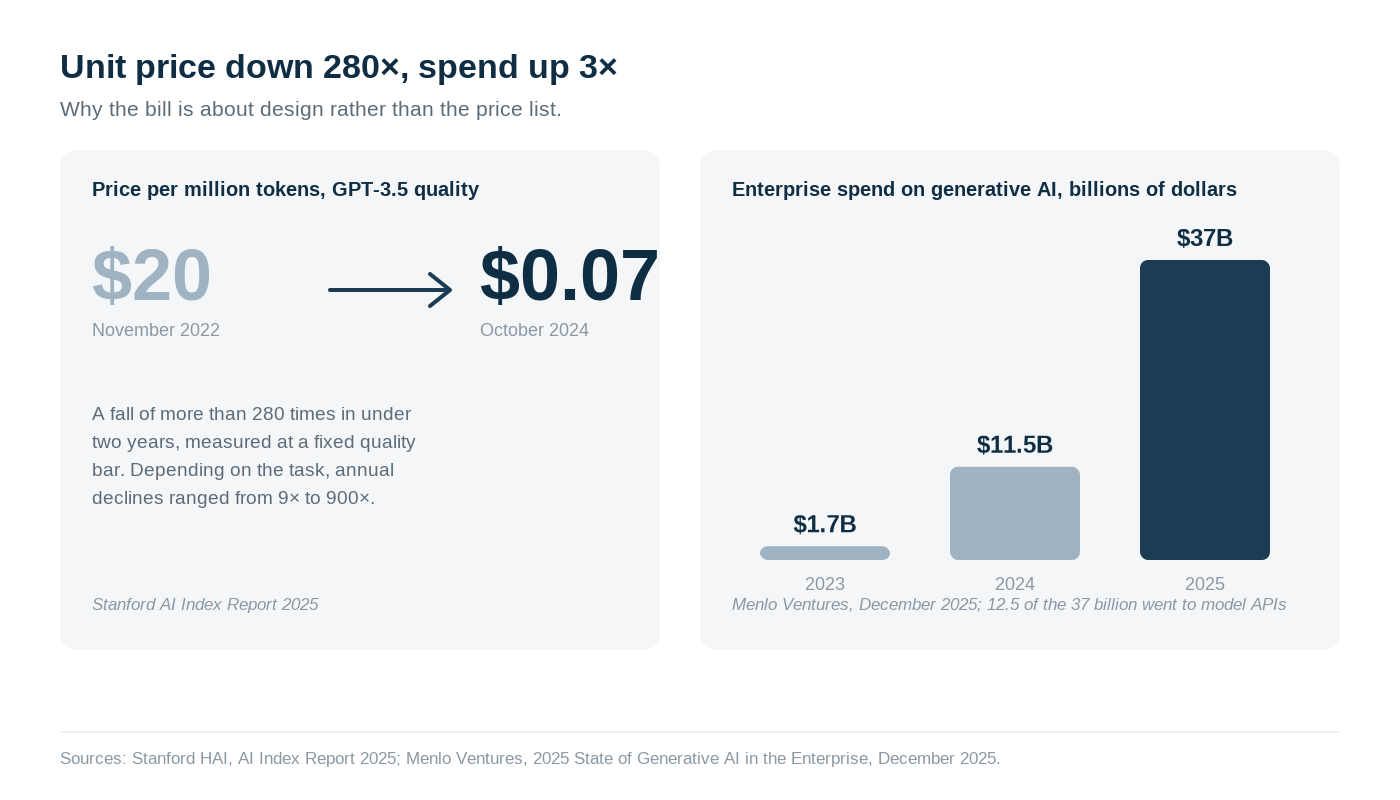
Stanford's 2025 AI Index measured the cost of running a model at GPT-3.5 quality falling from about 20 dollars per million tokens in November 2022 to 7 cents by October 2024, a drop of more than 280 times. Over the same period enterprise spending on generative AI went the other way. Menlo Ventures put it at 1.7 billion dollars in 2023, 11.5 billion in 2024 and about 37 billion in 2025, with 12.5 billion of that going to model APIs.
Both are true because unit price is the small variable. The bill is tokens per call multiplied by calls, and both of those are decided by how the system is designed. This post works through where the money goes, with a worked example, and what moves it.
Price down, spend up
The two trends are not in tension. Cheaper tokens make more uses viable, each use sends more context than the last, and agentic patterns multiply the number of calls per task. Menlo's figure for 2025 split almost evenly between applications, at 19 billion dollars, and infrastructure, at 18 billion, which is another way of saying that half the money is going into running models rather than buying software that happens to use them.
The AI Index also found that the price decline was not uniform: depending on the task, annual price falls ranged from nine times to 900 times. The practical consequence is that a budget built on this year's price list is wrong within a year, in a direction that depends on the task, and that the only durable number in the plan is the shape of the usage.
A worked example
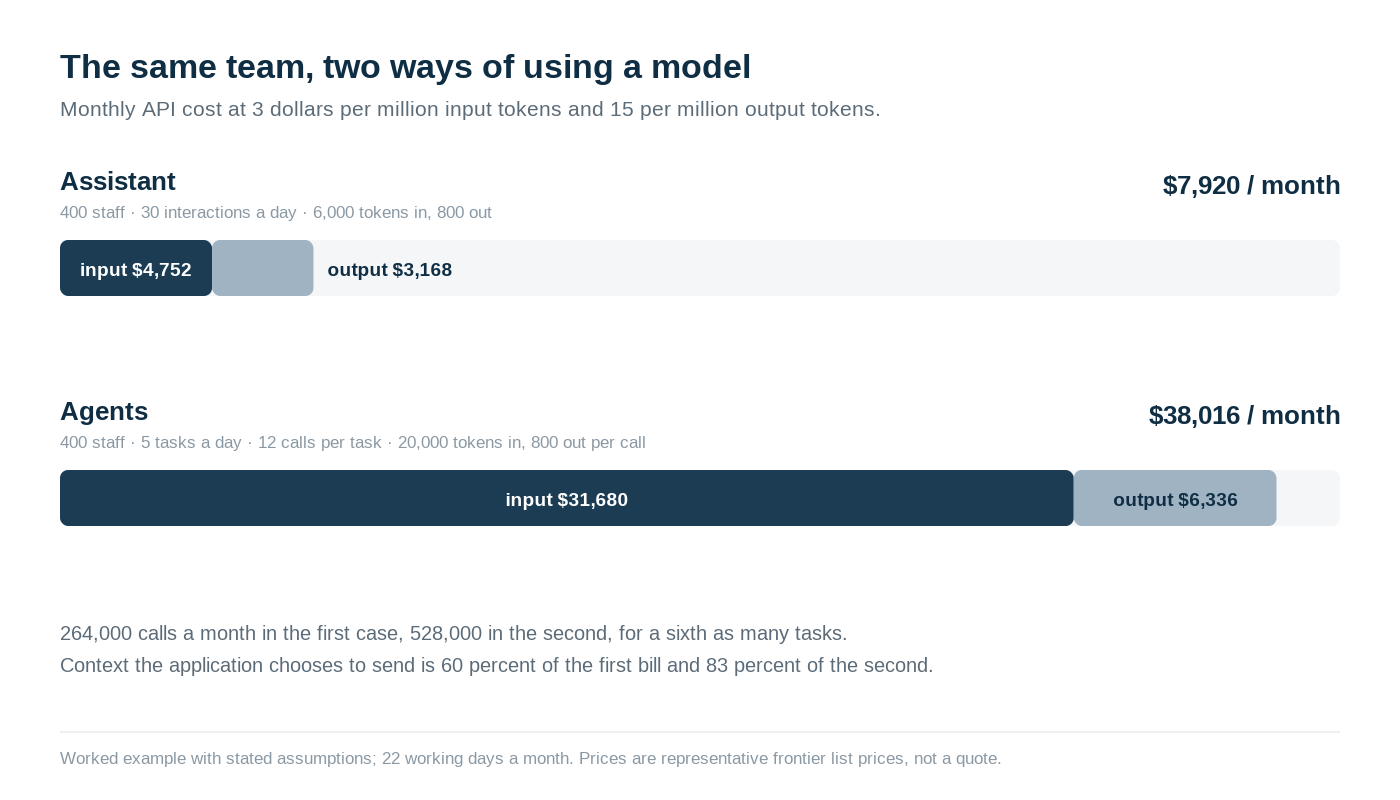
Take an internal assistant for 400 staff. Assume 30 interactions per person per working day, that each interaction sends 6,000 tokens of instructions and retrieved context and gets 800 tokens back, and representative frontier prices of 3 dollars per million input tokens and 15 dollars per million output tokens. These are assumptions, chosen to be ordinary rather than flattering.
That is the easy number, and it is not the frightening one. Notice that input is 60 percent of it, and that almost all of the input is context the application chose to send, not the question the person asked. A person types perhaps 40 tokens. The other 5,960 are instructions, retrieved documents and conversation history, every one of them a design decision.
- Calls: 400 people × 30 a day × 22 working days = 264,000 a month
- Input: 264,000 × 6,000 = 1.58 billion tokens, about 4,750 dollars
- Output: 264,000 × 800 = 211 million tokens, about 3,170 dollars
- Total: roughly 7,900 dollars a month, or 95,000 dollars a year
Agents change the multiplier
An agent that completes a task by reasoning, calling a tool, reading the result and repeating does not make one call per interaction. It makes eight or fifteen, and each later call carries the transcript of the earlier ones. The same 400 staff running five agentic tasks a day at twelve calls each, with context growing to an average of 20,000 tokens per call, is 528,000 calls and 10.6 billion input tokens a month, around 32,000 dollars for input and 38,000 in total. Nearly five times the cost of the assistant, for a sixth of the interactions.
This is not an argument against agents. A task that used to take a person forty minutes and now costs 86 cents of tokens is a bargain. It is the reason agentic cost has to be modelled per task rather than per seat, and why a task's call count and context growth are design parameters rather than things that happen.
The five levers, in order of effect
In most systems we review, the first two levers between them cut the bill by half or more, and neither changes the quality of answers. Routing is the lever that needs an evaluation suite behind it, because it is where a cost saving can quietly become a quality regression. Step caps are the lever most often missing entirely, which is how a looping agent produces a four-figure bill overnight.
- Send less context: retrieve the right four passages rather than the top twenty, and trim instructions nobody reads
- Cache the stable prefix: providers charge a fraction of the price for a repeated instruction and document prefix, which is most of an enterprise prompt
- Route by difficulty: a classifier or a small model handles the simple majority and escalates the rest
- Cap agent loops: a budget of steps and tokens per task, with a graceful stop and a message to the person
- Batch the asynchronous work: anything not waiting on a person can run at off-peak or batch prices
Cost without an evaluation harness is a guess
Every lever above trades something. Smaller context can drop the passage that mattered; a cheaper model can be wrong more often; a step cap can stop a task one step early. The only way to pull the levers safely is to have a fixed set of real tasks, with known good outputs, that runs after every change and reports accuracy next to cost per task.
That harness is the same one that answers the question the finance director will ask in month three, which is whether the system is worth it. Cost per task against the human cost per task is the number. Everything else is a token count.
Budget for the shape, not the price
Model prices will keep falling. Plan for that by making the model a swappable component behind the evaluation harness, so that a cheaper model next year is a configuration change and a test run rather than a project. Then spend your attention on the things price drops do not fix: context size, call count, and the agent loops that nobody set a budget for.
A useful discipline is to put three numbers on every AI feature before it ships: expected calls per month, expected tokens per call, and the ceiling at which someone gets paged. The first two are the budget. The third is what stops a bug from becoming an invoice.