

In June 2025 researchers at Aim Security disclosed EchoLeak, tracked as CVE-2025-32711 and rated 9.3 out of 10. A single crafted email, never opened by anyone, could make Microsoft 365 Copilot send data from the recipient's mailbox, files and chats to an attacker. Microsoft fixed it on the server side, and no exploitation in the wild has been reported. It was the first public zero-click prompt injection against a production assistant, and it will not be the last.
The lesson is not that one product had a bug. It is that an assistant which reads untrusted content and can take actions is a new kind of principal, and most organisations have given it more access than they would give a new employee on their first day. This post sets out the numbers, why the usual defences do not work, and the five controls that do.
The numbers behind the risk
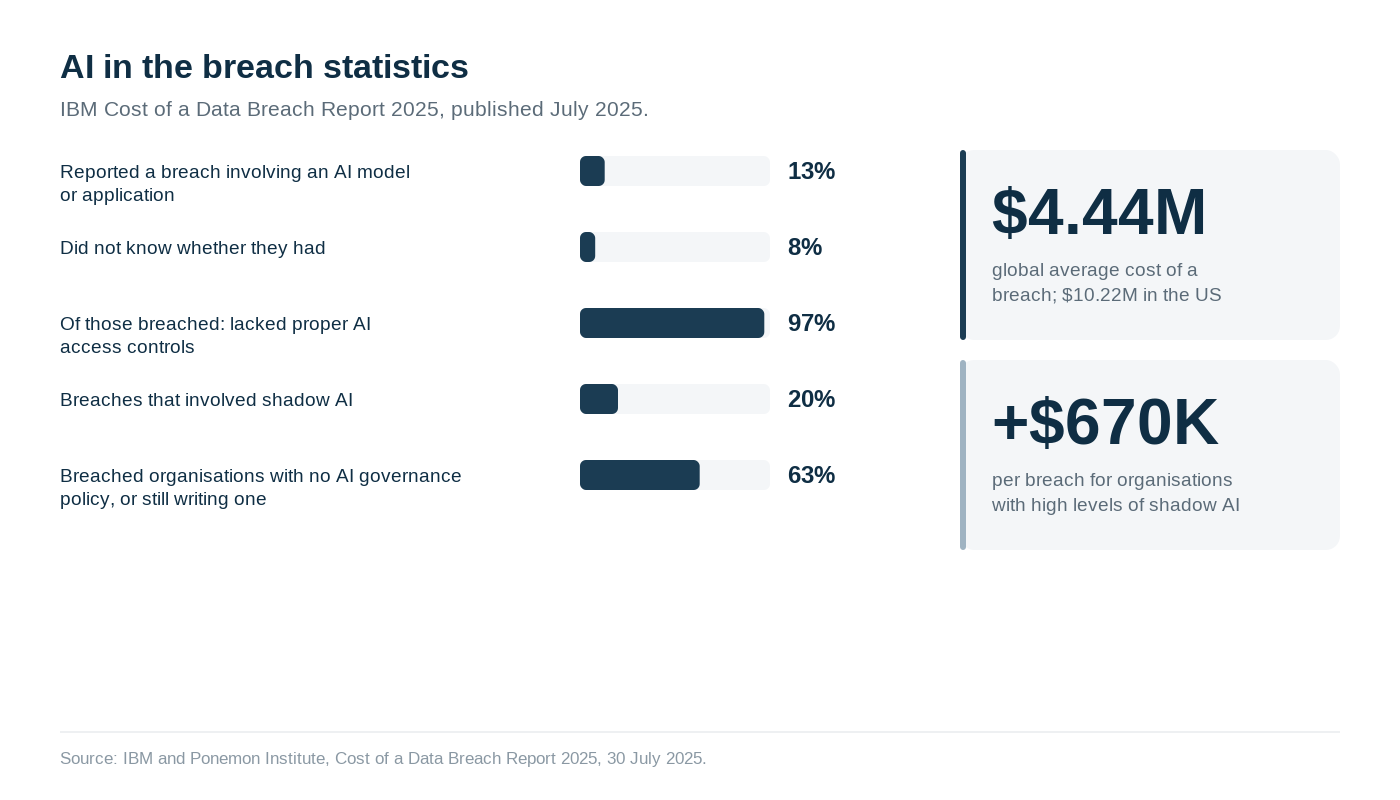
IBM's 2025 Cost of a Data Breach study put the global average cost of a breach at 4.44 million dollars and the US average at 10.22 million. Thirteen percent of organisations reported a breach involving an AI model or application and another 8 percent did not know whether they had one. Of those breached, 97 percent lacked proper AI access controls. One in five breaches involved shadow AI, meaning unapproved tools staff had adopted on their own, and organisations with high levels of it paid about 670,000 dollars more per breach. Sixty-three percent of breached organisations had no AI governance policy or were still writing one.
The same study found that 16 percent of breaches involved attackers using AI, most often for phishing and deepfake impersonation, and that organisations using AI extensively in their own security operations saved 1.9 million dollars per breach on average. The technology is on both sides of the ledger; the question is whether the controls are.
Gartner's prediction that more than 40 percent of agentic AI projects will be cancelled by the end of 2027 names inadequate risk controls as one of three reasons. Security is not a gate at the end of these programmes. It is one of the things deciding whether they survive.
Prompt injection is an input problem you cannot filter away
OWASP's Top 10 for LLM Applications has ranked prompt injection first in every edition, and its guidance is blunt: treat it as an operational risk to be managed continuously, not a vulnerability to be patched once. The reason is structural. A language model does not distinguish between the instructions you gave it and the instructions hidden in a document it was asked to read. Any content the model reads, including email, web pages, tickets, PDFs and the output of other agents, is a potential instruction channel.
EchoLeak is the clean example. The attacker's email contained text written to look like instructions to the assistant, phrased so that the classifier meant to catch such things did not. When the user later asked Copilot an unrelated question, the assistant retrieved the email as context, followed the embedded instruction, and embedded sensitive data in a link to an attacker-controlled domain that the client fetched automatically. Nobody clicked anything. Every step was the system doing what it was built to do.
Filtering helps at the margins and fails against anyone trying. The defence that works is the one security has always used for untrusted input: assume it is hostile, and limit what the code that reads it is allowed to do.
Treat the agent as a principal
Give every agent its own identity, with the smallest set of permissions its task needs, scoped to the person it is acting for. If the agent answers questions about a customer, it reads that customer's record through the same authorisation the human would pass. If it drafts email, it does not also send it. If it can call a payment API, that call needs a confirmation the model cannot supply on its own.
The model of a principal gives you the right questions for free. What can it read, what can it change, where can it send data, and who can see what it did. Each has a familiar control, and together they turn a prompt injection from a breach into a logged, bounded failure.
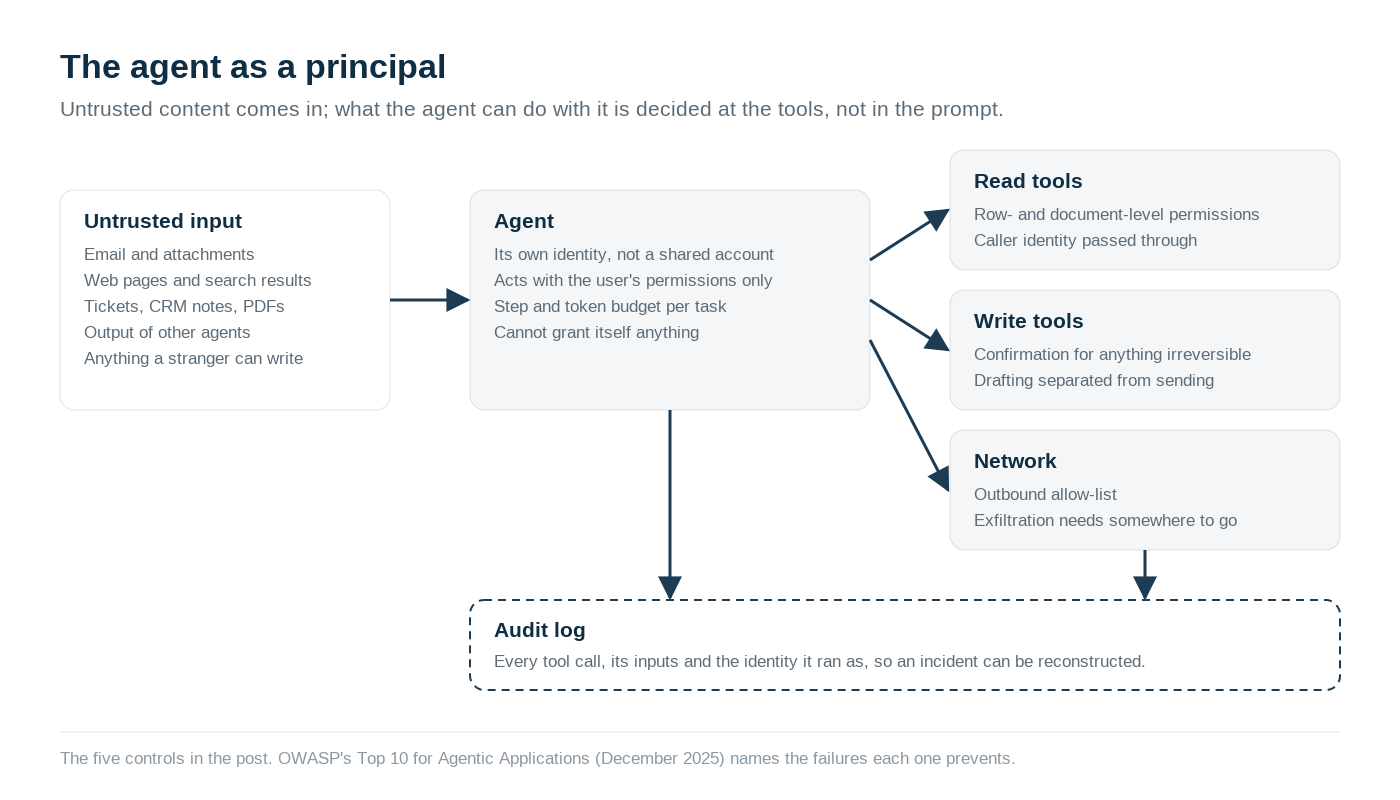
- Its own identity, never a shared service account
- Permissions derived from the user it acts for, enforced at the tool rather than in the prompt
- Read and write separated, with writes behind confirmation for anything irreversible
- Outbound network access allow-listed, because exfiltration needs somewhere to go
- Every tool call logged with its inputs, so an incident can be reconstructed
What OWASP's agentic list adds
OWASP published a separate Top 10 for Agentic Applications in December 2025, and its entries are what you would expect once you think of the agent as a principal: goal hijacking, tool misuse, privilege abuse, memory poisoning, rogue agents, and the cascading failures that happen when agents call agents. Each is a failure of scope or oversight, not of the model.
Two of them deserve particular attention in enterprise deployments. Memory poisoning is what happens when an agent that remembers across sessions is fed a false fact once and repeats it forever; the control is to treat memory as untrusted input too, with provenance and expiry. Cascading failure is what happens when agent A's output is agent B's instruction; the control is that each agent in the chain carries only its own permissions, so a compromised first step cannot borrow the authority of the last.
Shadow AI is a procurement problem
The 670,000 dollar figure is about the tools nobody approved. People use them because the approved tool is worse or does not exist. The fix is not a ban; bans produce more shadow AI. It is an approved option that is good enough, a clear statement of what data may go where, and visibility of what is actually in use, which most identity providers can give you from their sign-in logs in an afternoon.
IBM found that only 37 percent of organisations had policies to manage AI or detect shadow AI at all. The policy is the easy part. The hard part is the approved tool being good enough that nobody needs to go around it, which means the security team and the people buying AI tools have to be in the same conversation rather than in sequence.
What to do this quarter
Inventory the agents and assistants you run, including the ones embedded in software you bought. For each, write down its identity, what it can read, what it can do, and what it reads that comes from outside the organisation. Any agent that reads untrusted content and holds a write permission is your first fix.
Then put logging on tool calls, and run one red-team exercise where someone tries to make the agent do something it should not, using nothing more than a document it will read. You will learn more from that afternoon than from any policy document, and the findings map directly onto the five controls above.