
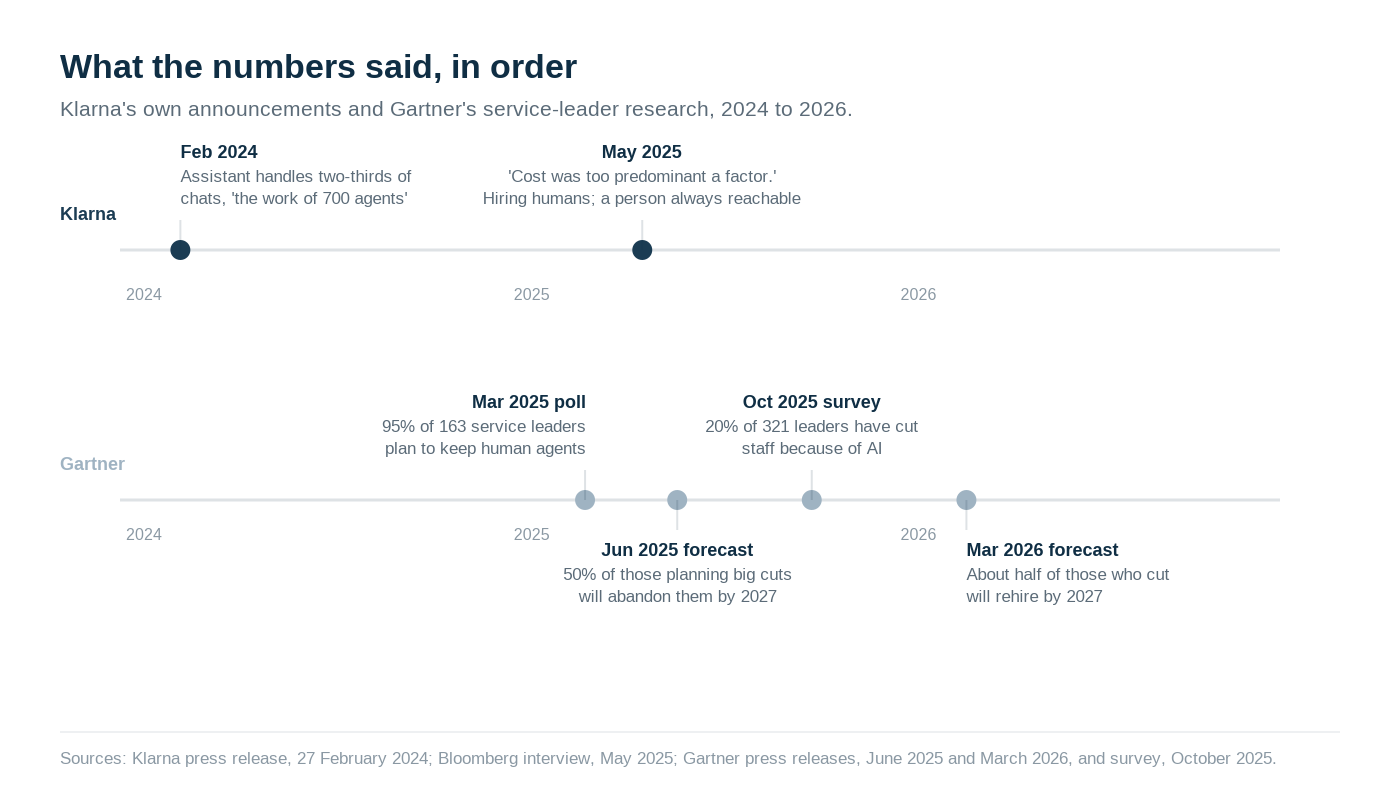
In February 2024 Klarna announced that its AI assistant had handled two-thirds of customer service chats in its first month, 2.3 million conversations, and was doing the equivalent work of 700 full-time agents. In May 2025 its chief executive told Bloomberg that cost had been too predominant an evaluation factor, that the result was lower quality, and that the company was hiring people again and would make sure customers could always reach a human.
Klarna is the famous case, not the unusual one. Gartner predicted in June 2025 that by 2027 half of the organisations planning to significantly reduce their customer service workforce would abandon those plans. Its October 2025 survey of 321 service leaders found that only 20 percent had cut staff because of AI at all, and in March 2026 it forecast that around half of the companies that had cut service headcount citing AI would rehire into similar roles by 2027. The common thread is a metric, and this post is about replacing it.
What the numbers said, in order
It helps to lay the announcements out in sequence, because the sequence is the argument. Klarna's February 2024 release was a cost story: fewer agents, faster resolution, a projected 40 million dollar profit improvement. Gartner's March 2025 poll of 163 service leaders found 95 percent planning to keep human agents, which at the time read as caution. Klarna's May 2025 reversal, Gartner's June 2025 forecast, its October 2025 survey and its March 2026 rehiring forecast then arrived in that order.
None of this says automation failed. Klarna still runs the assistant and describes the new approach as scalable AI with high-quality human support. What failed was the way the first result was measured, and that failure is reproducible in any organisation that uses the same metric.
Deflection measures what you stopped doing
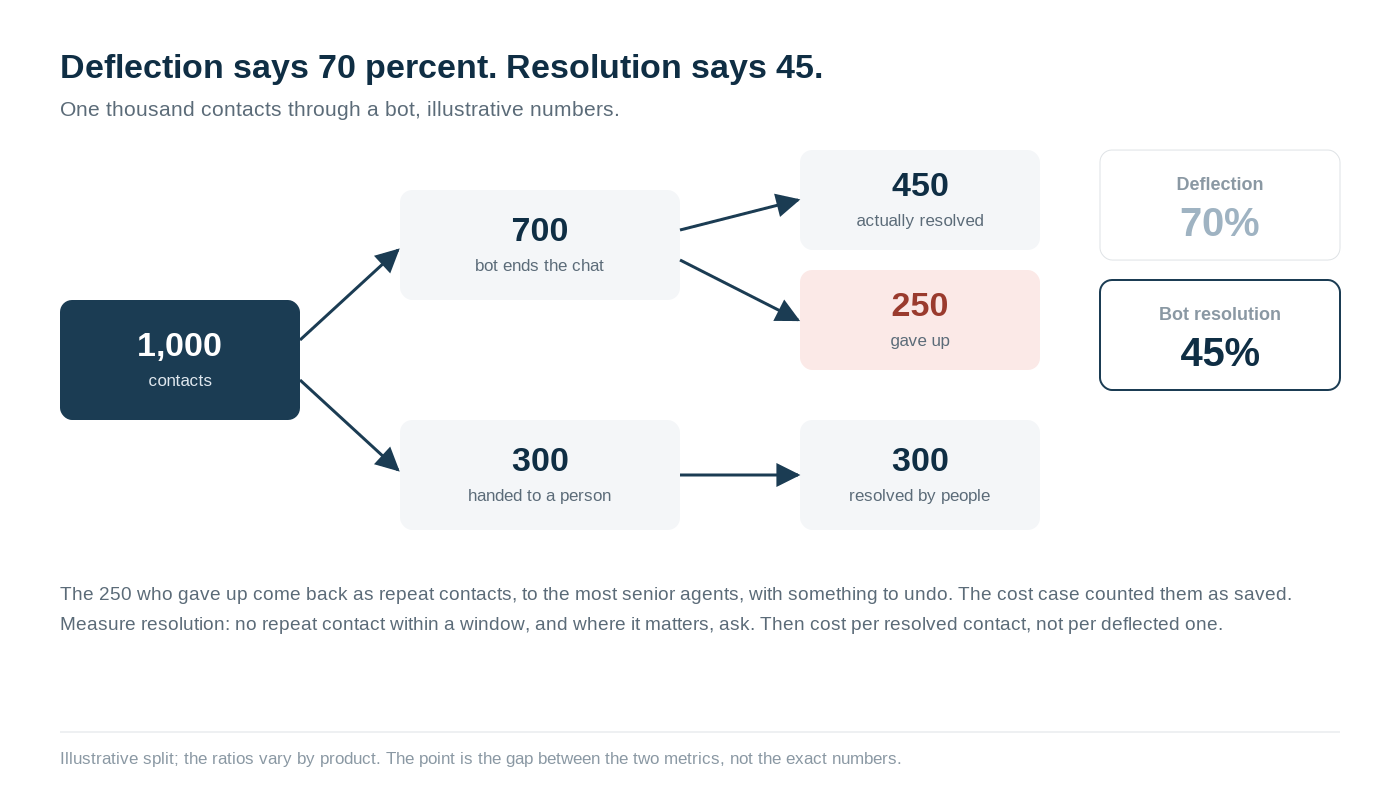
Deflection is the share of contacts the bot ended without a human. It is the number vendors quote and the number a cost case is built on, and it has a flaw: it counts a customer who gave up as a success. A bot that is confidently unhelpful, that loops, or that buries the route to a person will post excellent deflection while the problem walks out of the door to a chargeback, a complaint, a regulator or a competitor.
The replacement is resolution: the share of contacts where the customer's problem was actually solved, verified by the absence of a repeat contact within a window and, where it matters, by asking. Resolution is harder to measure and lower than deflection. It is also the number that correlates with the things the business cares about, which is why finance will eventually ask for it whether or not the service team volunteers it.
The gap between the two can be large. In the illustrative split below, a bot that ends 70 percent of conversations resolves 45 percent of them, and the quarter of customers who gave up are invisible to the deflection number entirely.
Containment has a cost on the other side
Every contact a bot fails to resolve is a second contact, handled by a human who now also has to undo whatever the bot did, with a customer who is angrier than they were. In the accounts we have reviewed, that second contact costs more than the first would have, and it lands on the most experienced agents, because they are the ones who can repair it. The cost case counted the first contact as saved and the second as noise.
A fair model counts both: the contacts the bot resolved at bot cost, the contacts it failed at bot cost plus escalation cost plus the repair premium, and the contacts that were never resolved at the cost of the customer. That model often still favours automation. It favours a different automation, and it usually favours a smaller first step than the vendor proposed.
- Resolved by the bot: bot cost per contact
- Failed and escalated: bot cost, plus human handle time, plus the repair premium for undoing what the bot did
- Failed and abandoned: the lifetime value at risk, the complaint cost, and in regulated sectors the reporting cost
- Handed over cleanly: bot cost plus a shorter human contact, because the context came across
Automate the task, not the conversation
The deployments that held up did not try to replace the agent. They took the parts of the contact that were lookups and actions, where is my order, change my address, resend the invoice, confirm the refund, and did those well, fully integrated with the systems of record. They gave the human agent the same assistant, so the summarising, the searching and the drafting got faster. And they measured handle time and resolution for both, not deflection for one.
This is the same lesson MIT drew from the wider population of generative AI pilots: the returns were in the back-office and process work, not in the customer-facing conversation. Service is where that distinction is sharpest, because the conversation is the brand and the task is the cost.
- Lookups and status questions, where the answer is in a system and the risk is low
- Transactions with clear rules, with the action written back and confirmed
- Summaries, suggested replies and knowledge search for the human agent
- Triage and routing, so the right person gets the contact first time
- After-call work: wrap-up notes, categorisation, follow-up tasks
The human path is a feature
Klarna's conclusion, that customers must always be able to reach a person, is also what Gartner's data says service leaders believe: 95 percent of those it polled in March 2025 planned to keep human agents. Hiding the human path raises deflection and lowers everything else. The design that works makes the handover visible and fast, and carries the context across so the customer does not repeat themselves. The handover rate then becomes a diagnostic rather than a failure.
A handover that works has three properties. The customer can ask for it in plain words and get it without a fight. The agent who receives it sees the conversation so far, the account, and what the bot already tried. And the reasons for handover are categorised and reviewed weekly, because they are the best available list of what to automate next and what to stop automating.
A scorecard that will survive the finance review
Resolution rate, repeat-contact rate within seven and thirty days, handover rate and time to a human, handle time for the human after a handover, and satisfaction split by resolved and unresolved. Cost per resolved contact, not cost per deflected one. Report it monthly, next to the pre-automation baseline, and break it down by contact type so the lookups that work are not averaged in with the complaints that do not.
If the numbers are good, the cost case writes itself. If they are not, you find out in month two rather than in a press interview a year later. Either way the service team ends up owning a number the rest of the business believes, which is worth more than any single quarter's saving.