
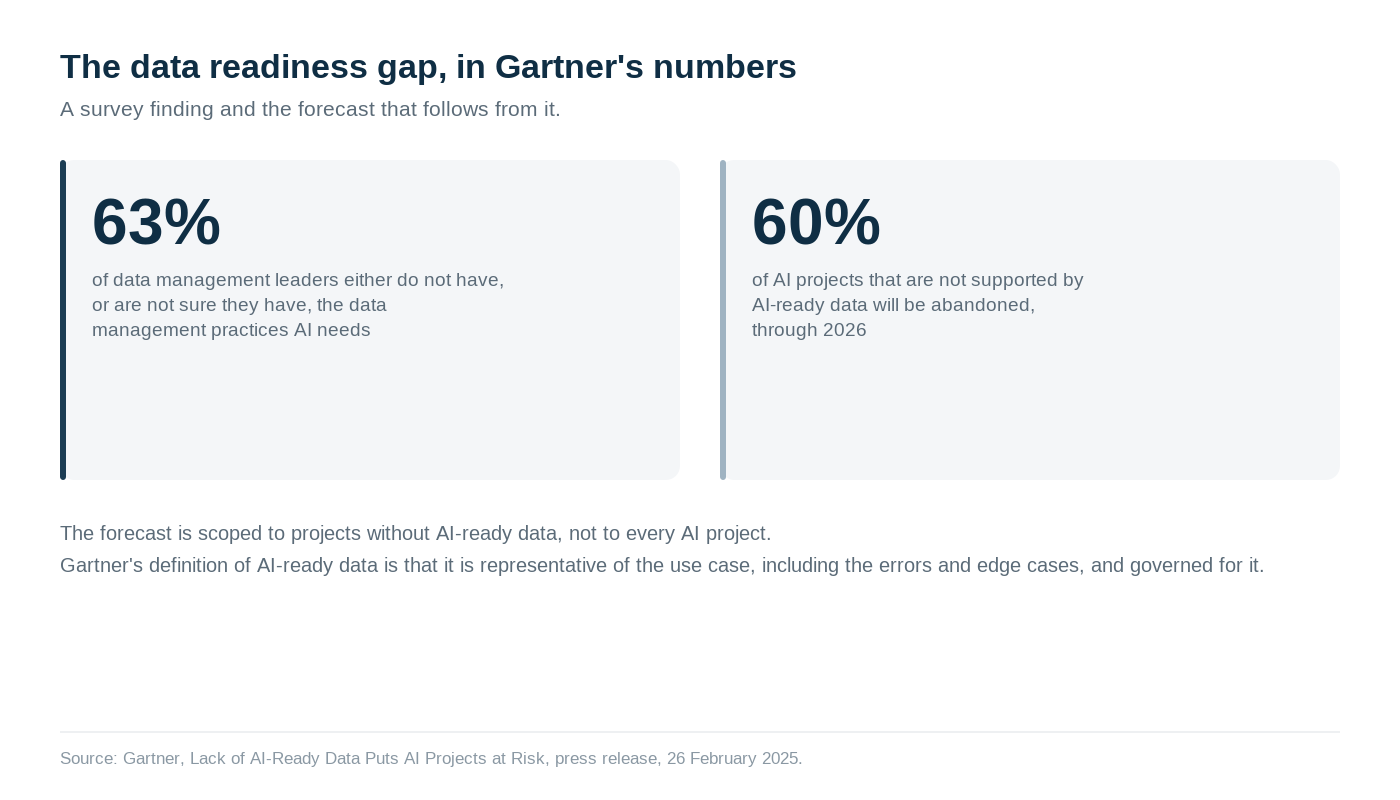
In February 2025 Gartner predicted that through 2026 organisations would abandon 60 percent of AI projects unsupported by AI-ready data, and reported that 63 percent of the data leaders it surveyed either did not have, or were not sure they had, the data management practices AI requires. We are near the end of 2026 and the prediction has aged well. Most of the failed projects we see failed on data, and most of those failures were foreseeable.
The reason the problem is worse with AI than with reporting is that AI puts the data in front of people who were never allowed near the warehouse. A wrong number in a dashboard is seen by an analyst who knows it is wrong. A wrong number in an assistant's answer is seen by a customer, a clinician or an auditor, with the model's full confidence attached.
The gap, in Gartner's numbers
Gartner's definition of AI-ready data is worth quoting because it is not the usual one. Data is AI-ready when it is representative of the use case, including every pattern, error, outlier and unexpected emergence the model will meet in production, and when it is governed for that use. Clean data in the reporting sense can fail that test; a dataset scrubbed of its errors teaches a model that errors do not exist.
The forecast is scoped, too. It is 60 percent of projects without AI-ready data, not 60 percent of all projects. Read that way it is a statement about sequencing: the projects that start on a prepared foundation mostly survive, and the ones that start on an unprepared one mostly do not, regardless of how good the model or the team is.
Readiness is four properties, not a quality score
Teams tend to answer the readiness question with a data quality percentage. That measures the wrong thing. A dataset can be complete and accurate and still be unusable by a model, because the model needs to know things a human analyst carries in their head: which version of the price list applied, who is allowed to see this row, where the number came from.
Each of these is an engineering requirement with a known solution. None of them is produced by a cleansing exercise, and each one is cheaper to build before the assistant exists than after.
- Governed: a named owner, a definition, and a process for changing either
- Dated: every record carries when it was true, not only when it was written
- Permissioned: who may see it is attached to the data, not to the application
- Traceable: an answer can be followed back to the rows and the version it came from
Effective dates are the one everyone misses
Most business data is a sequence of states: a price list, a policy, a contract, an org chart. Warehouses commonly store the current state and overwrite. A model reading that warehouse will answer a question about last quarter with this quarter's numbers and no way to know the difference.
Retrieval systems make it worse, because they index documents, and the document that ranks highest is often the most-edited one rather than the one that was in force on the date the question is about. It is common to find an assistant quoting a fee schedule that has been superseded twice, because the superseded versions are the ones most of the intranet still links to. Versioning and effective dating have to exist in the source before any retrieval layer can respect them, which is why we treat them as a prerequisite rather than a feature.
Permissions belong on the data
The second most common failure is an assistant that answers correctly with information the person asking was not entitled to. It happens because permissions live in the applications, and the model was given a service account that can read everything. IBM's 2025 breach study found that 97 percent of organisations reporting a breach of an AI model or application lacked proper AI access controls. The pattern starts here.
The fix is row-level and document-level permissions enforced at retrieval time, with the caller's identity passed through rather than replaced. It is more work up front, and it is the difference between an assistant that can be rolled out to the whole organisation and one that has to stay with the twelve people who could see everything anyway.
Lineage is how you debug a wrong answer
When an assistant gives a wrong answer, the question is which input was wrong. Without lineage that is an afternoon of guesswork; with it, it is a lookup. Lineage also answers the question every regulator and every internal auditor is going to ask about an AI-influenced decision: what did the system know, and where did it come from.
Practically this means retrieval returns identifiers and not just text, pipelines record their inputs and versions, and the application stores what it showed the model alongside what the model said. The storage is cheap. Not having it is not, and under the EU AI Act's logging duties for high-risk systems it stops being optional in December 2027.
A readiness assessment that takes two weeks
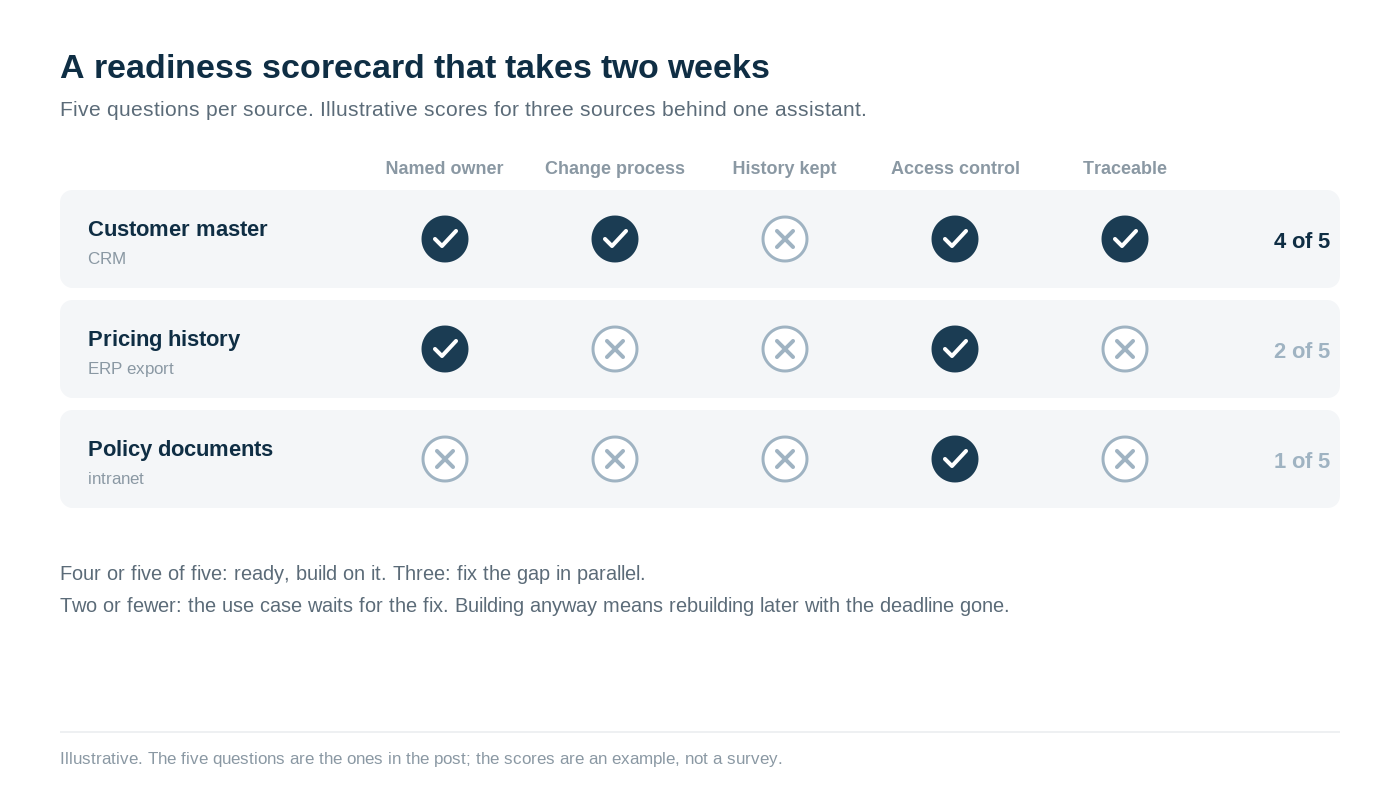
Pick the three sources an AI use case depends on. For each, write down the owner, how a change is made, whether history is preserved, how access is controlled, and whether a row can be traced to its origin. Score honestly. A source that fails two of five is not ready, and the use case that depends on it should be sequenced after the fix, not in parallel with it.
This sounds slow. It is faster than the alternative, which is building the assistant, discovering the problem in user testing, and rebuilding the pipeline with the deadline already gone. In the illustrative scorecard below, the customer master is ready to build on, the pricing history needs its change process and its history fixed first, and the policy documents need an owner before anything else.