

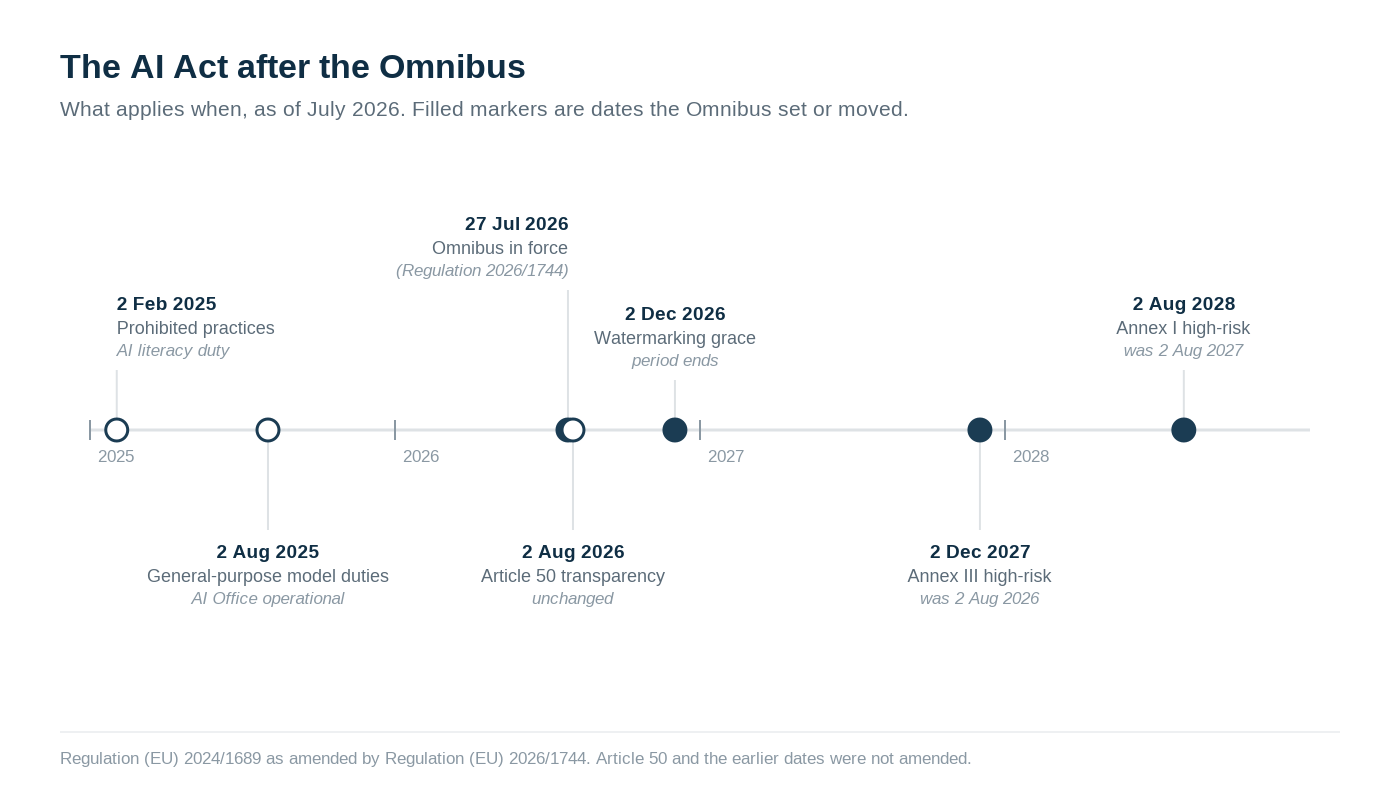
In July the Digital Omnibus on AI became law as Regulation (EU) 2026/1744, in force from 27 July 2026. It moved the application date for most high-risk AI systems from 2 August 2026 to 2 December 2027, and for AI embedded in regulated products such as medical devices and machinery to 2 August 2028. A lot of programmes exhaled.
The exhale is mostly misplaced. Three sets of obligations were untouched and are live today, and the part of high-risk compliance that takes longest, knowing which systems you have and what they decide, does not get faster because the deadline is later. This post sets out what applies now, what moved, and a plan that fits the time.
What applied on 2 August 2026 anyway
The Omnibus did not amend Article 50. Since 2 August 2026 a system that interacts with people has to make that clear, generated or manipulated images, audio and video have to be marked as such in a machine-readable way, and deployers have to disclose deepfakes and AI-generated text published to inform the public on matters of public interest. The only softening is a grace period: generative systems already on the market before that date have until 2 December 2026 to mark their output.
Two older obligations are also in force. The prohibited practices in Article 5 have applied since 2 February 2025, as has the duty in Article 4 to ensure staff who work with AI have a sufficient level of AI literacy. The Omnibus softened the wording of Article 4 from ensuring a level of literacy to supporting its development, which changes what you have to show, not whether you have to do anything. The obligations on general-purpose model providers have applied since 2 August 2025, and the AI Office has been operational since the same date.
- Article 50 transparency: disclosure to people, marking of synthetic media, deepfake labelling
- Article 5 prohibited practices, in force since February 2025
- Article 4 AI literacy for staff, in force since February 2025 and softened in July 2026
- General-purpose model provider duties, in force since August 2025
What moved, and for whom
Annex III lists the stand-alone uses the Act treats as high risk: biometric identification, management of critical infrastructure, education and vocational training, employment and worker management, access to essential services including credit scoring and life and health insurance pricing, law enforcement, migration, and the administration of justice. Those obligations now apply from 2 December 2027.
Annex I covers AI that is a safety component of a product already regulated under EU product law: machinery, medical devices, in-vitro diagnostics, vehicles, lifts, toys. Those now apply from 2 August 2028, alongside the sectoral conformity regime they sit inside.
If you are a bank, an insurer, a hospital group or a public body, the first list is the one that matters, and fifteen months is less than it sounds. A credit scoring model, a CV screening tool and a patient triage score are all plainly in scope, and all three usually arrive from a vendor.
Why fifteen months is not long
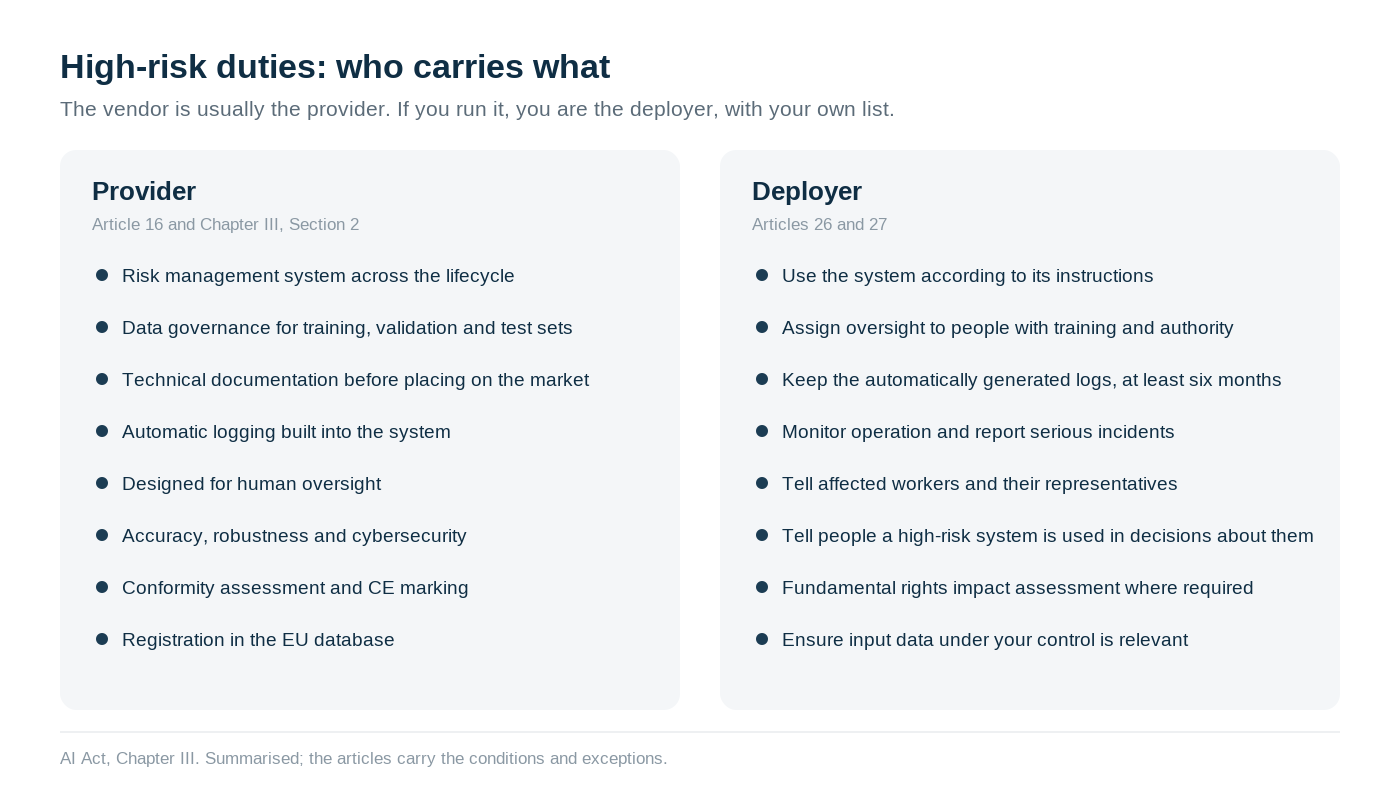
The obligations for a high-risk system are a risk management system, data governance, technical documentation, logging, human oversight, accuracy and robustness, and a conformity assessment, with registration in the EU database before the system is used. None of that is exotic. All of it assumes you can produce a list of the systems in scope, who owns them, what data they were trained and tested on, and what decisions they influence.
In our experience that inventory is the long pole. It is not hard to write down; it is that nobody has had a reason to, so the models in the credit decisioning path, the CV screener a vendor bundled into the HR suite, and the triage score a department bought on a company card all live in different places with different owners. Gathering them is a project in itself, and it has to finish before the compliance work can start.
- Every model, rule set or vendor feature that influences a decision about a person
- The owner, the vendor if any, and the data it was trained and tested on
- Where its outputs go and who can override them
- Whether the human in the loop actually has the time and the information to intervene
Vendors will not do this for you
Most of the AI in a large organisation arrives inside something else: a CRM, an HR platform, a claims system, a monitoring suite. Under the Act the vendor is the provider and you are the deployer, and deployers have their own duties: using the system as instructed, assigning human oversight to people with the training and authority to exercise it, keeping the automatically generated logs for at least six months, monitoring operation and reporting serious incidents, informing affected workers and people, and in some cases carrying out a fundamental rights impact assessment.
The practical consequence is that your supplier questionnaire needs a new section, and your contracts need the right to the documentation the Act requires: the instructions for use, the technical documentation summary, the conformity declaration and the logging capability. Ask for it now, while the vendor is motivated, rather than in the autumn of 2027 when every customer is asking at once.
The penalties did not move either
The fines are unchanged: up to 35 million euros or 7 percent of worldwide annual turnover for a prohibited practice, up to 15 million euros or 3 percent for breaching the high-risk and most other obligations, and up to 7.5 million euros or 1 percent for supplying incorrect information to a regulator, in each case whichever is higher. The Omnibus clarified the AI Office's competence and reinforced its enforcement powers rather than reducing them.
For most organisations the realistic exposure before December 2027 is not a fine. It is a supervisory question from a sectoral regulator, a complaint about an undisclosed chatbot, or a procurement that stalls because a public-sector buyer asked for Article 50 compliance evidence and the vendor had none. All three are cheaper to prevent than to answer.
A plan that fits the time
Autumn 2026: inventory and classification, with a named owner per system and a decision on which Annex III category, if any, it falls under. Winter: close the Article 50 and Article 4 gaps, because they are live and are the easiest for a regulator to check. 2027: risk management, logging, oversight and documentation for the high-risk set, with the conformity assessment and registration last.
The sequencing matters because the early steps are cheap and the late ones are not. A programme that spends 2026 arguing about scope and 2027 building everything will miss December. One that has the inventory by Christmas can spend 2027 on the systems that are actually in scope, which in our experience is a shorter list than the first workshop assumed.