

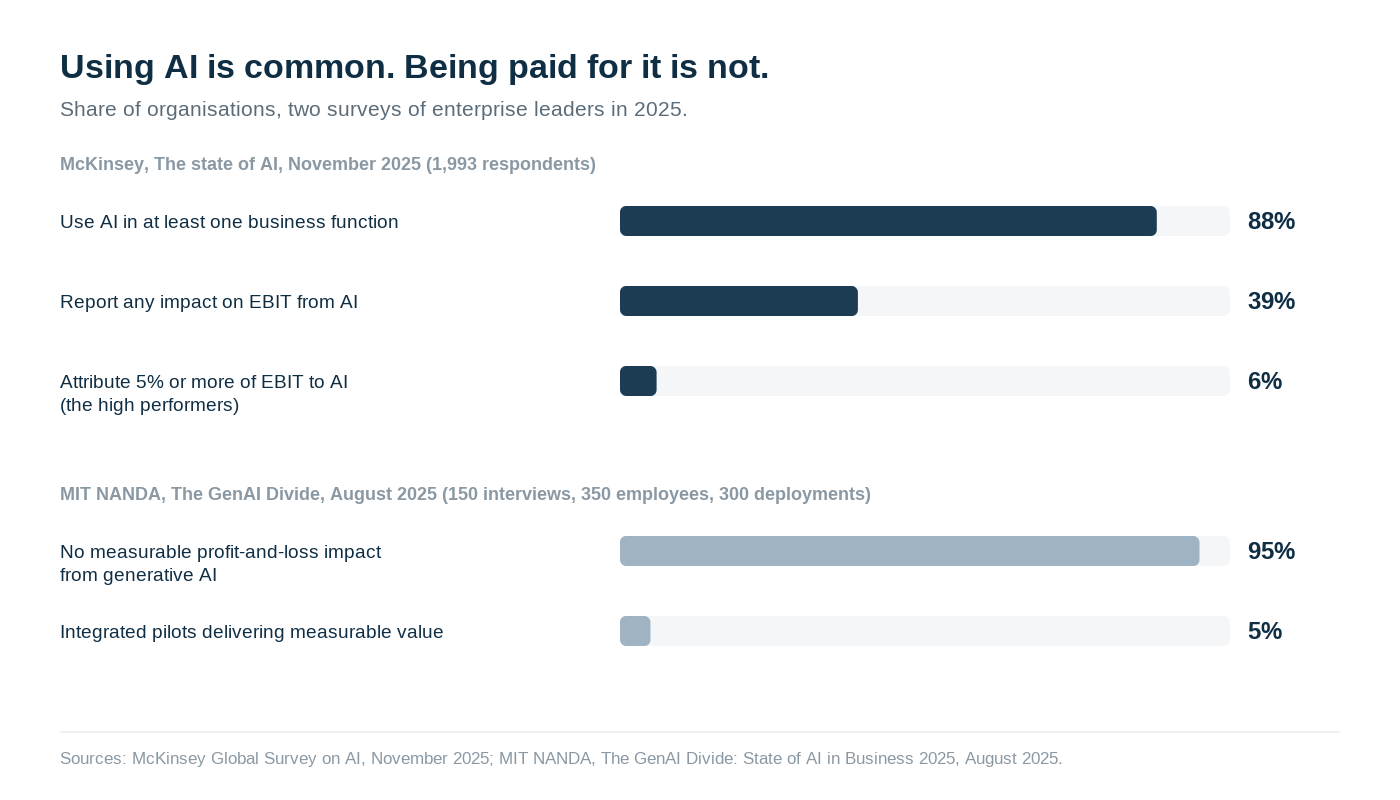
MIT's NANDA initiative published The GenAI Divide in August 2025, built on 150 interviews with leaders, a survey of 350 employees and a review of 300 public deployments. The headline was that 95 percent of organisations had seen no measurable profit-and-loss impact from generative AI. The 5 percent that had were not using better models.
McKinsey's survey three months later put the same shape on larger numbers: 88 percent of 1,993 respondents used AI in at least one business function, 39 percent reported any effect on EBIT, and most of those reported less than 5 percent. About 6 percent qualified as high performers. The gap between using AI and being paid for it is the whole story, and it is a delivery problem.
Two studies, one shape
The two pieces of research asked different questions of different populations and landed in the same place. McKinsey measured breadth: nearly nine in ten organisations use AI somewhere, up from 78 percent a year earlier. MIT measured depth: of the organisations that had deployed generative AI, almost none could point to a line in the accounts that had moved because of it.
Put together, the picture is of a technology that has been adopted everywhere and integrated almost nowhere. That is not a verdict on the technology. The 5 percent and the 6 percent exist, and in both studies they are distinguished by how they deployed rather than what they deployed.
The pilot proves the wrong thing
A pilot is designed to show that the model can do the task. It is run by enthusiasts on clean examples with a human checking every output. It succeeds, because models are genuinely good at the task, and the organisation concludes that the hard part is done.
The hard part was never the task. It is the thirty minutes a day of someone's job that has to change for the output to be used, the system of record the answer has to be written back to, the exception path when the model is unsure, and the person who is accountable when it is wrong. The pilot demonstrated none of that, so the business case that followed was built on the easy half.
MIT's interviews named the mechanism. The tools most organisations piloted did not retain feedback, adapt to context or improve over time, so the pilot's results were the ceiling rather than the floor. Users described them as fine for a first draft and useless for the part of the job that mattered, and went back to the consumer tools they already used, which is why the report found a thriving shadow AI economy alongside the stalled official pilots.
Budgets go where the demo is, returns come from where the work is
MIT found that more than half of generative AI budgets went to sales and marketing, while the clearest returns came from back-office automation: document handling, reconciliation, procurement, outsourced processing, the work that is repetitive, measurable and has a queue. That is not a coincidence. Back-office tasks have a baseline cost per item, so the saving is visible, and they already have a process the model can slot into.
A customer-facing pilot has neither. Its value depends on behaviour you cannot measure cleanly, and it has to be right in public. If you want a first production win, pick the dullest high-volume process you own, not the one that looks best in a board deck. The deck can come later, with a number in it.
Agents multiply the problem
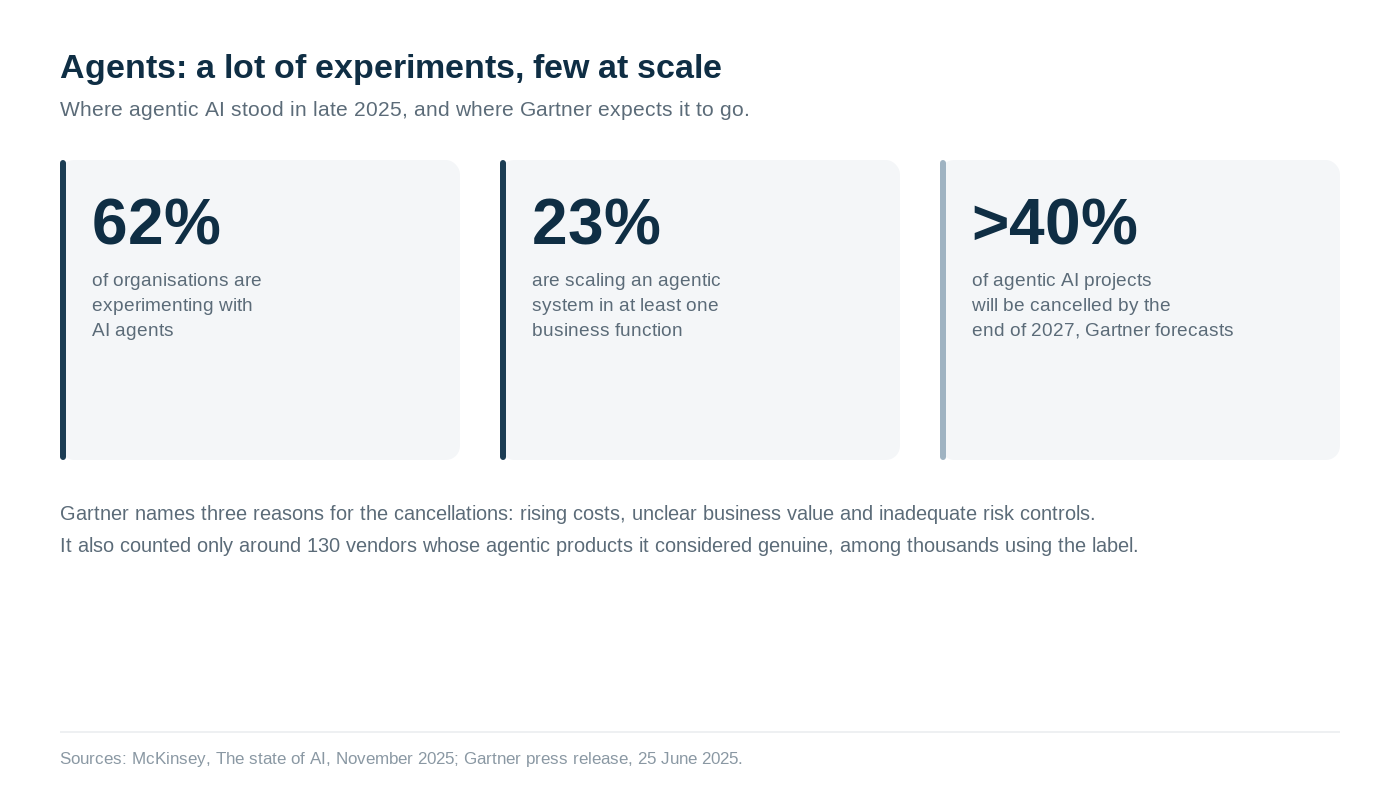
The current wave is agents, and the numbers are early. McKinsey found 62 percent of organisations experimenting with agents and 23 percent scaling one anywhere. Gartner predicted in June 2025 that more than 40 percent of agentic AI projects would be cancelled by the end of 2027 over cost, unclear value or inadequate risk controls, and counted only around 130 vendors whose agentic products it considered genuine among the thousands claiming the label.
An agent is a pilot with more steps. Every integration the pilot skipped is now a tool call that has to be authorised, logged and recoverable, and every ambiguity in the workflow is now a decision the agent will make on its own. The organisations scaling agents are the ones that did the integration work for ordinary AI first.
What the 5 percent did differently
The pattern across both studies is consistent. The successful deployments were owned by the line manager whose process changed, not by a central AI team that handed over a tool. They bought or built systems that retained context and learned from feedback rather than static prompts, and MIT found that purchased, partnered deployments reached production about twice as often as internal builds. They started with one workflow, measured it against the old cost, and extended from there. And they redesigned the workflow around the model rather than bolting the model on to the workflow.
McKinsey's high performers show the same habits at a larger scale. They are nearly three times as likely to have fundamentally redesigned workflows for AI, far more likely to have senior leaders visibly accountable for it, and about three-quarters of them are scaling AI across the enterprise against a third of everyone else. None of those are properties of a model.
- A named business owner whose process changes, with a number they are measured on
- Write-back into the system of record, not a separate window
- An explicit path for the cases the model cannot handle
- A baseline measured before the pilot, so the result can be compared with something
- A feedback loop, so the system in month six is better than the one in month one
Where to start on Monday
Take the pilots you have and ask three questions of each: who is accountable for the outcome, what does the output get written into, and what happens when it is wrong. Any pilot without an answer to all three is a demo, and should be either finished or closed. Finishing one properly is worth more than starting four.
Then measure. Time per item, items per day, error rate and rework, before and after. The organisations in the 5 percent can tell you those numbers. That is most of what separates them, and it is the only thing that will survive the next budget round.